"As soon as we're born, we're old enough to die." — David Stern
Part 1: No Bad Parts?
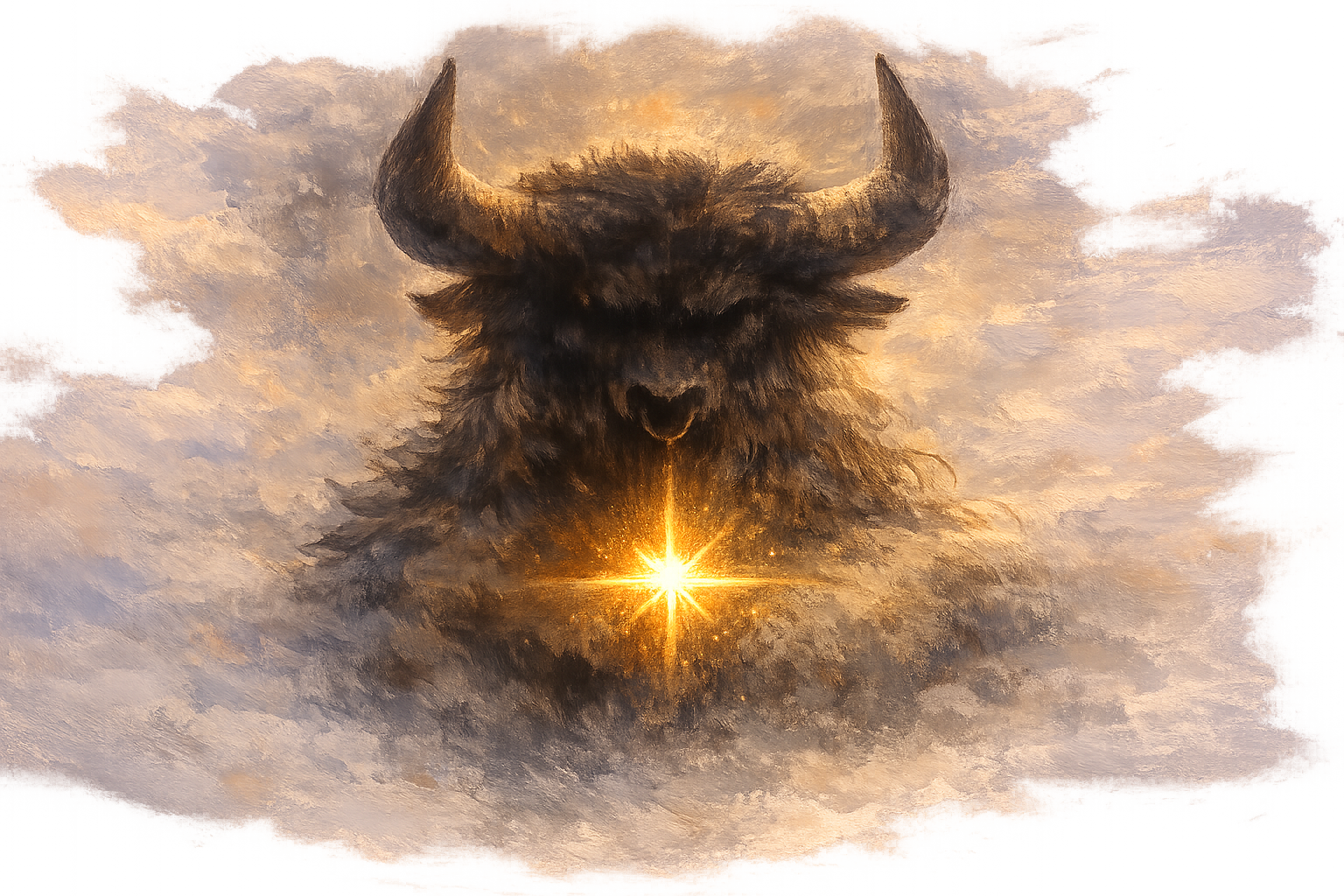
At the centre of every labyrinth is a Minotaur, and at the centre of every Minotaur is a star.
Likewise, at the centre of every part of us is a piece of starlight. This starlight is surrounded by human qualities that may have become distorted — sometimes extremely so — as with the Minotaur. We see versions of this in the natural world. Some forests evolve in relationship to frequent fire. Thick bark, sealed cones, rapid regrowth — these are signs of intelligence shaped by threat.
When conditions change, the same protective adaptations can become devastating. What once preserved life begins to destroy it. This is also true of human systems. The ongoing problem is not the forest, nor the fire, but the protection left governing long after the conditions that shaped it have shifted.
The phrase "no bad parts" opens the heart to the difficult aspects of humanity through a compassionate lens. It says the fire in the forest long ago matters. No wonder the bark is thick and the cones are sealed. With curiosity and courage it also asks:
What does it mean to say there are no bad parts when the impact of our actions — inner or outer — causes real harm? How can we accept ourselves, or a world, that perpetuates cycles of pain?
Rather than dissolving the tension between impact and intention, Internal Family Systems invites us to stay with both. To stay is to accept complexity and acknowledge pain. As Mike Elkin puts it:
"Protectors don't protect" — but they are trying, and once they did.
In Greek myth, the Minotaur is a bull-headed beast: dangerous, flesh-eating, exiled to the centre of a labyrinth. And yet his name was Asterion — meaning star. A being born of broken vows and fear, whose impact is devastating, but whose origin is not evil, but essential. The Greeks did not deny the danger of the Minotaur; nor did they strip him of meaning or power. He is both beast and star — both threat to life and life itself.
To say no bad parts does not make Minotaurs into teddy bears. It says that Minotaurs are Minotaurs because their truth was, at some point, hidden instead of held. It says they are not proof of evil; they are proof of adaptation.
IFS asks us to hold impact and intention together, without collapsing one into the other. It invites us to look more closely at what happens to systems that are shamed and oppressed — and what becomes possible when such experiences are spoken for instead of denied or covered up.
Drawing on Dick Schwartz's reflections on Self-leadership in a climate of fear, we can see how terror, separation, and shame shape not only inner systems, but collective ones as well. What feels dangerous is pushed away, contained, or destroyed in the hope that safety will return. But this does not restore life — it narrows it. It replaces curiosity with certainty and mistakes control for care.
In the Minotaur myth, killing the beast does not heal the kingdom. The labyrinth remains. Cycles of betrayal continue. Without realisation, the story is preserved — and with it, what gave rise to the beast in the first place.
From an IFS perspective, lasting change requires a way of relating that can stay in contact with what frightens us without us being overtaken by fear; that can recognise the power of shame without shaming. Seen this way, no bad parts is a refusal to abandon meaning — and a refusal to abandon all life. It is a commitment to reintegration rather than eradication.
Part 2: Facing Terror and Reconciling Parts
If the Minotaur shows us what happens when protection is exiled and feared, the following story shows what becomes possible when parts are allowed to meet again — not abstractly, but in lived, imaginal experience. Parts do not only long to be restored in relationship with Self; they also long to be reconciled with one another. When parts are unburdened, reconciliation between them often supports renewal in the system as a whole.
I was working with a legacy burden in which there was a part holding the terror of being found out and later executed. I found her in her kitchen, reordering the pots and pans. She was stuck in the moment before the men came to take her away — holding the belief that if she stayed there, the loss would never come. She would not die. She would not suffer. She would not lose her son.
Unfortunately, staying in that place of terror was holding the system there too and making other protective parts respond accordingly.
Another part seemed connected to her, often appearing in contrast, though I could not initially understand why. This other part was human, but dressed as a fairy. As I worked with the terrified woman in the kitchen and helped her move out of that frozen moment and into a forest, she was reunited with the fairy — and something quietly magical happened. I realised they both carried burdens of betrayal, but in very different contexts. They had responded to life in very different ways. One became comforting and mystical; the other hyper-vigilant and obscured. It was only when they came together that the wolves appeared and the moon came out.
There is something profoundly healing about connecting human to human — our losses and our dreams — even when we are different and drawing from different contexts. Self seems to witness this with awe. And it is something that invites the wolves and the moon, because it speaks not only to personal healing, but to collective healing. Each of these parts needed one another in order to change. Self-presence made movement possible. Reconciliation with each other made letting go possible. Two different movements. Two responses to the same rupture — two ways of carrying the same loss — until they could re-member one another again.
In this instance, innocence is not naïveté. It is openness, immediacy, aliveness — a time before parts had to separate in order to survive. These two parts would once have been aspects of a whole, carrying different qualities rather than opposing roles. Experience is what happens when the world wounds, overwhelms, or frightens us — and parts begin to divide into roles in response to threat. They take their positions, so to speak. This division separates them from one another, even as they continue to share the same loss and remain rooted in something essential together.
Part 3: Integration
IFS does not aim to return us to innocence, nor to undo experience. It creates the conditions for parts to come back into relationship — not as they once were, but as they were meant to be, informed by what they have lived through.
Integration is not the disappearance of roles, but their softening, so that the system can reorganise around connection rather than threat.
- Innocence — wholeness before division
- Experience — division shaped by threat
- Integration — wholeness informed by experience
This is not a return to innocence. It is a way of living in which innocence is available and treasured — and protection is no longer operating alone, but grounded, honoured and supported.
Where Does That Leave the Minotaur?
There once was a boy whose parents could not love him. He was born from many things — fear, shame, betrayal — but not love. So they hid him away and told him he was a monster. And in time, he became one. Locked in darkness, unnamed and unseen, he learned that violence was the only way to feel his own power. When others entered the labyrinth, he tore them apart — not because he was evil, but because destruction was the only language he knew.
He did feel power in those moments, and many knew his name — but there were long stretches in between and, whilst each act promised relief from shame every time left him feeling more alone and more monstrous.
One day someone came who did not deny what he had done. They did not excuse the harm, instead they asked him to name it. They helped him see the corners of that place with all the bones, cracks and shadows. They showed him treasures too that had been forgotten there. They also gave him something he had never been given: his name and told him he was made of starlight like all things. He did not fully believe in his starlight but he did remember his name. Hearing his name took him back to somewhere full of warmth and light and song. The place before.
Leaving the labyrinth was not easy. His body resisted. His shape ached. He had to surrender in so many ways. Formed by this confinement, he was frightened of his face in the light, of what others would think of him and of there being nowhere to hide. Slowly, in relationship, he learned that strength did not require exile and that power did not have to destroy what it touched.
One night, many days later when his beard had grown and he had learnt to walk in the sunlight he saw the star again, just as he was falling asleep. It thanked him for looking after it when nothing else could. It told him hope was about remembering and said…
"Amidst complexity and pain…here I am — the star that waits and wakes when it is called!"
Behind the myth, the pathologies, and the constraints; inside a boy whose parents could not love him, a piece of starlight called.