How relationship brings us back to life
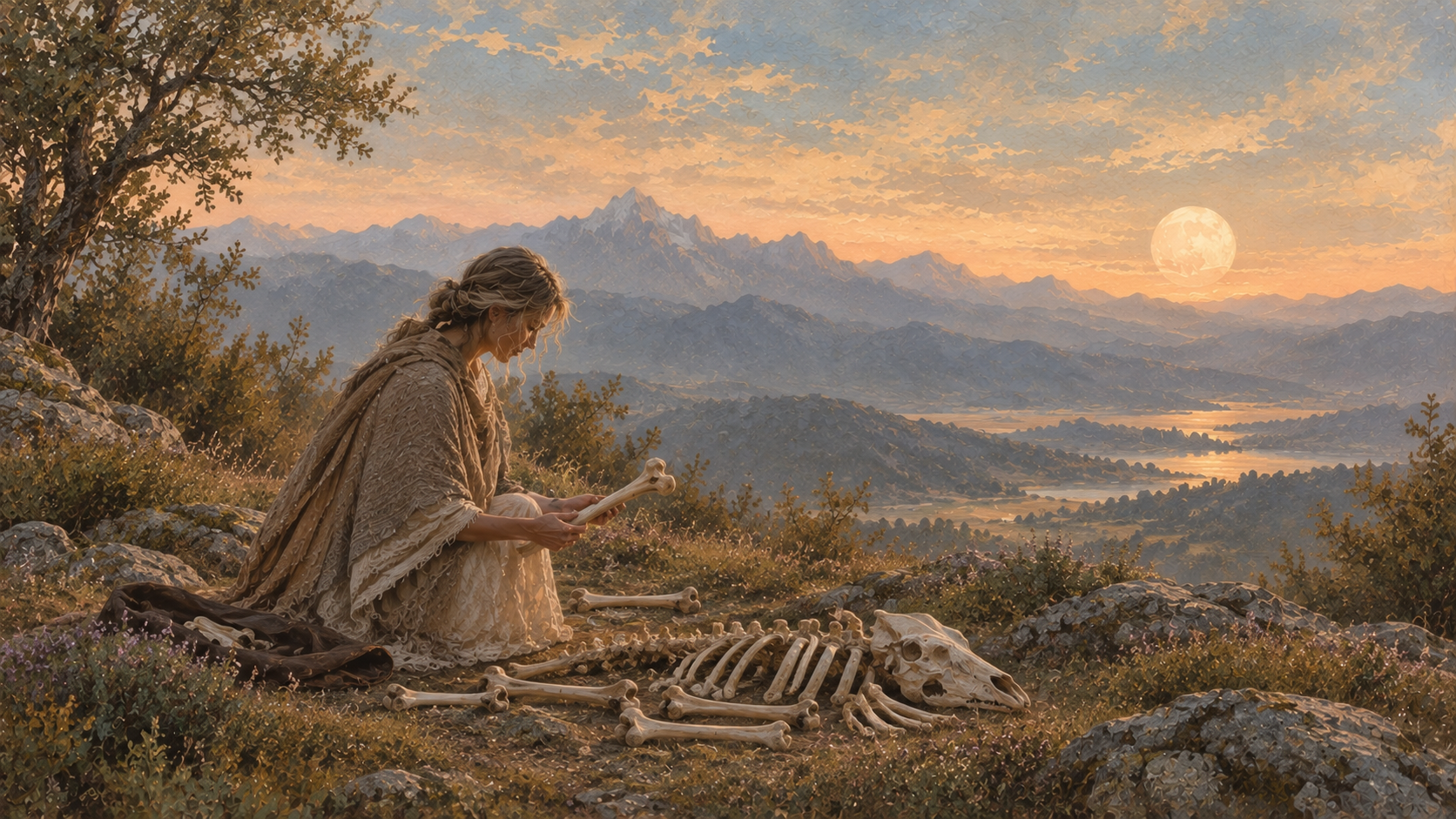
There is a resurrection story in the book Women Who Run With the Wolves about an old woman who wanders the desert collecting the bones of wolves. Slowly, patiently, she gathers them until she has assembled an entire skeleton. And when every bone is in place, she begins to sing. As she sings, flesh begins to form over the bones. The wolf's body returns. Its fur grows. It begins to breathe. And eventually, the wolf gets up and runs away.
I keep returning to this image when I think about psychotherapy.
Gathering
Often we come to therapy because something no longer makes sense. We may know fragments of our story without understanding how things belong together. We might feel quite lost. We start to speak and wonder about our experience. We become curious about different parts of ourselves. We notice feelings, memories and patterns that perhaps we have never really considered before.
Slowly, we gather the pieces. But gathering the bones is only the beginning.
Looking at What We Have Gathered
At some point, we have to look. And perhaps this is one of the most difficult parts of therapy. Because when we look closely at what we have gathered, we don't only see the individual bones. We begin to see the relationships between them — and the spaces where relationship has been lost.
We acknowledge the still, lifeless nature of some of these pieces. We encounter different layers of our experience. What happened, but also what didn't happen. What we needed and didn't receive. What was lost along the way. What had to become separated or protected. What we have carried without fully knowing that we were carrying it. All of this happens as we gather and collect ourselves.
And there can be something difficult in encountering ourselves as not yet entirely known to ourselves as space emerges between parts; in seeing the bones gathered before us and recognising that they do not yet make a living whole, or that something is incomplete.
It can be tempting to move away, to make meaning quickly, to find an answer and to try and put the bones together before we have really looked at them or found every one.
We need all the bones. Not because therapy is about constructing some perfect or completed version of ourselves, but because what has been separated needs the possibility of being encountered and brought into relationship. As Osnat Arbel, an IFS lead trainer, once put it to me: "We are all just trying to find a way home."
And this is where the story changes. Because the old woman does not simply gather the bones. She then sings over them.
Singing
Understanding our patterns matters. But transformation isn't simply the accumulation of more accurate information about ourselves. Something else happens when what has been fragmented can be encountered again through song. And in this context song means loving presence, another spirit responding with the experience of being a human too.
Relationship doesn't simply help us understand what is there. It changes what becomes possible between the things that are there. The looking is where loss and grief belong. And singing doesn't erase what has been seen. It allows those gathered and acknowledged pieces to enter a new kind of relationship — to be honoured, rather than left separate or unseen.
What Does That Feel Like?
From the inside, therapy rarely feels like watching the bones assemble neatly into a wolf. It can feel painful and disturbing sometimes. Like the woman we wade in water getting nibbled by minnows, and sometimes we slip, and often we are waking in the coolness of the water. Often we don't know exactly what we are looking for. Something seems significant before we understand why. We stay with an experience without knowing where it will lead. That is why it is hard to do such things alone, or with someone we don't trust. But with the right company it does lead somewhere, and another piece is found.
To follow what we do not yet understand requires courage and a certain kind of faith. Not necessarily faith that everything will be all right, or even faith that we know where we are going. More a willingness to believe that something may be happening before we can fully know it, and that we are not alone. That the path will emerge through the walking of it. That what feels fragmented may contain the possibility of a form we cannot yet see.
Therapy can help us feel safer within the uncertainty of life, not because uncertainty disappears, but because we become more connected to life, and safer within ourselves. We have become accustomed to a type of uncertainty that is experienced as nurturing.
Reorganisation
In Internal Family Systems therapy, we sometimes talk about parts becoming less burdened and the internal system reorganising. The bones remain part of the wolf. Our history remains our history. But the relationship between things can change, and so the whole changes also.
What was isolated can become connected. What was frozen can move. And gradually, something begins to take form. Therapy creates new conditions in which integration and recovery become possible. And then, sometimes, life seems to know what to do next.
The wolf grows flesh. It takes a breath. It stands. And eventually, it runs.
The challenge is believing in a wolf that is yet to materialise.