"… the realisation of human potential is a spontaneous thing, just like in a plant, life is spontaneous, we don't have to teach parts to grow up … it unfolds, our role is to provide the conditions for nature to do its job." — Dr. Gordon Neufeld
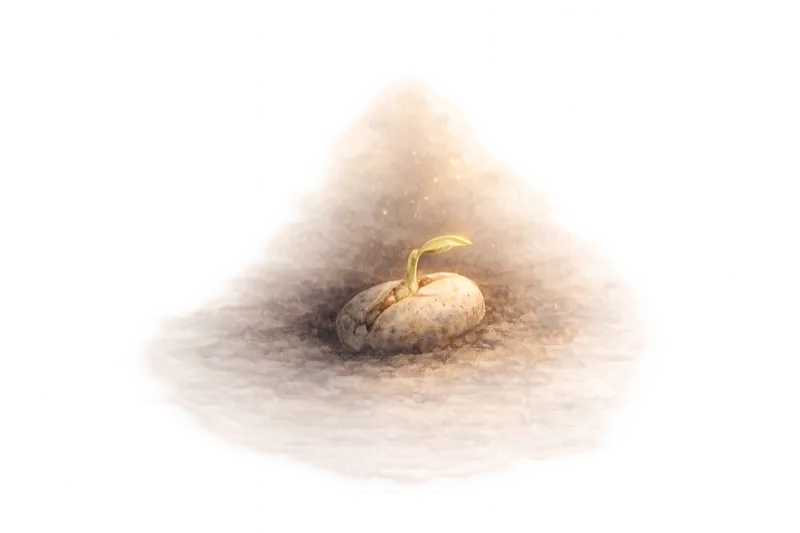
Carl Rogers once described finding potatoes stored in the cellar of his childhood home. They had been left in darkness, without soil or care — and yet each one had sent out a pale shoot, reaching toward a small window high in the wall. For Rogers, this captured something essential about human beings:
- Growth is already oriented toward life.
- Conditions shape how we grow — not whether we grow.
Surviving Instead of Thriving
When we grow up under conditions that require survival growth continues but it becomes constrained. Not expansive. Not well-nourished. Shaped by what is possible rather than what is needed. This is not a personal failing. It is what living systems do under pressure and we can work with this.
A Parts Perspective (IFS)
From an Internal Family Systems (IFS) perspective, this is how parts get into extreme roles.
When conditions are unsafe or unpredictable:
- Some parts manage, control, or perform
- Some parts work to prevent pain or rejection
- Some experiences feel too risky and are pushed out of awareness
Under these conditions, it can become hard to imagine living differently — not because change is impossible, but because the conditions don't yet allow it.
Conditions for Survival
When safety is limited, systems often organise around:
- Control or chaos
- Resistance and containment
- Separation or self-attack
- Black-and-white thinking
- Fear, shame, hopelessness
- Short-term fixes
- Unsafe certainty
- Unrealised or "impossible" dreams
These realities or ways of being are not who you are. They are how your system learned to survive but they create realities and these realities can be challenging. The good news: challenges can force us to imagine better.
Stepping Back
If we step back, something important becomes visible. We are not broken. We are living systems that adapted. Like the potato in the cellar:
- We grew with what was available
- Our adaptations made sense at the time
- The shape of our growth reflects our conditions, not our worth
And conditions can change.
Conditions of Worth
Carl Rogers described conditions of worth — the learning that acceptance, love, or safety depend on feeling, behaving, or being a certain way.
Over time, the system learns:
- Some experiences are allowed
- Others must be controlled, hidden, or rejected
Growth continues but it becomes organised around belonging rather than authenticity.
Therapy as a Change in Conditions
From a person-centred and IFS perspective, change does not happen through pressure or correction. It happens when the conditions shift.
When experience is met with...
- Acceptance rather than evaluation
- Curiosity rather than judgement
- Safety rather than demand
...the system no longer has to organise itself around survival.
Conditions for Change
As safety increases, systems naturally reorganise toward...
- Calming and regulation
- Responsiveness rather than reactivity
- Connection and compassion
- Curiosity and flexibility
- Embodiment
- Small, meaningful steps
- Safe uncertainty
- Sustainable hope
This is not forced transformation. It is an organic movement from survival into regulation.
IFS in Practice
IFS shows how conditions of worth become internalised and how they soften.
Very simply:
- Manager parts try to meet the conditions
- Protector parts prevent further harm
- Therapy creates enough safety for parts to step back
No part is forced to change. Parts update naturally when the conditions they learned in are no longer present.
In Closing...
The potato did not need to be fixed. It did not need to be convinced to grow. What mattered was the presence of light and the cultivation of conditions that were better suited for growth. In therapy, we help you to come to understand the needs of parts - needs that will contribute to better conditioning for growth and self care. It's all written inside. Parts know what they need.
Today, I accept myself as I am — whilst allowing in a little of my own light.